
In Denver’s Globeville, and Elyria-Swansea (GES) neighborhoods, families live alongside highways, industrial facilities, and now a massive data center. This is one of the most polluted areas in the country; the people who live here have been leading the work to change that for generations.
At the Alliance Center, we’re a hub connecting our community to the people doing this work and to their next step in it. That’s why we were proud to help promote and join the Pollution and Solutions Tour, hosted by the Green House Connection Center (GHCC) and Colorado Sierra Club with Cultivando and Earthworks, and to hear from neighbors and leaders of the GES community and other fenceline communities across the Denver metro area.
About the tour
On Wednesday, October 7 the Pollution and Solution tour brought together medical professionals, elected officials, impacted residents, organizers, academics, and neighbors for a bus tour of three sites that show what cumulative pollution looks like on the ground: the CoreSite Data Center in Elyria-Swansea, the Suncor Refinery in Commerce City, and the QTS Data Center in Aurora.
As GHCC Founder Harmony Cummings put it, “It is imperative for decision makers to come physically to the places where environmental and health harms are happening so they can experience firsthand what residents face daily while hearing directly from those most affected.”
What we saw
At CoreSite, we stood beside a massive industrial data center near apartments, senior housing, a recreation center, a park, and a community health center, in a community that has carried generations of industrial pollution. We heard from several community leaders and elected officials that this site was not something supported by the community.
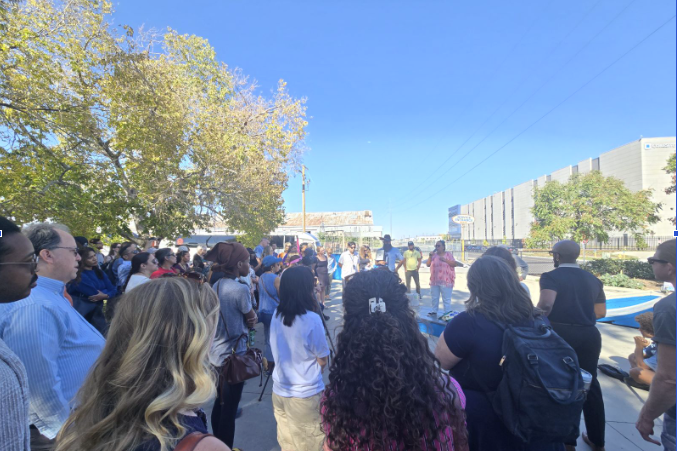
First stop: CoreSite Data Center
At Suncor, with Earthworks, we saw the refinery’s proximity to homes, schools, and playgrounds, along with footage of the smokestack captured by an optical gas imaging camera. Earthworks’ Andrew Klooster noted that the refinery is one of the largest sources of harmful pollutants in the state and ranks among the worst of comparable refineries nationwide.
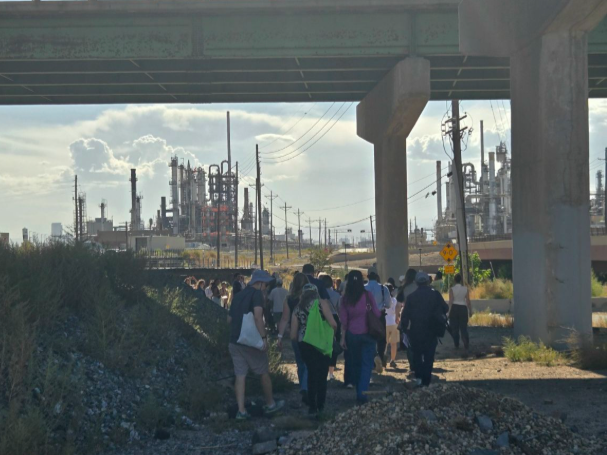
Second stop: The Suncor Refinery in Elyria-Swansea
Our final stop, QTS in Aurora, showed that this isn’t a one-neighborhood problem. Here, the data center sits close to the homes of the people who live around it. Local policymakers shared that they can see the site and hear the facility’s generators from their own homes. For them, this isn’t an abstract land-use question. It’s the sound and sight of daily life in their neighborhoods. Hearing that from the people who represent these communities, standing in front of the site itself, made clear that data center impacts reach across city lines, from Elyria-Swansea to Aurora.
Between stops, community leaders, health experts, and artists spoke on the buses, bringing together lived experience, science, music, and Indigenous wisdom.
The public is paying attention, too. A recent Magellan Strategies poll found that 86% of registered Colorado voters oppose a data center near their neighborhood, 82% say data centers use too much water, and 78% say they drive up household electricity costs.
What participants told us
Sixteen participants completed the post-tour survey, and the response was overwhelmingly positive: 88% said the tour deepened their understanding of the challenges and opportunities in the ecosystem, and 75% said it helped them feel like a stronger, more effective changemaker. One parent who attended with her daughter wrote that seeing basketball hoops and trampolines so close to the refinery was “next level,” and that the group’s “thoughtful planning and beautiful hearts give me hope.” Others said they made valuable connections on the bus, and a CSU PhD student studying data center impacts on the Front Range reached out to collaborate. That’s exactly the kind of connection we hope events like this spark.
Your next step
Many participants asked how to stay involved, and that’s where the Alliance Center comes in!
Some more ways to get connected:
Thank you to the entire GHCC team for their leadership, to our fellow partners at Colorado Sierra Club, Earthworks, and Cultivando, and to everyone who rode, spoke, and showed up.
